
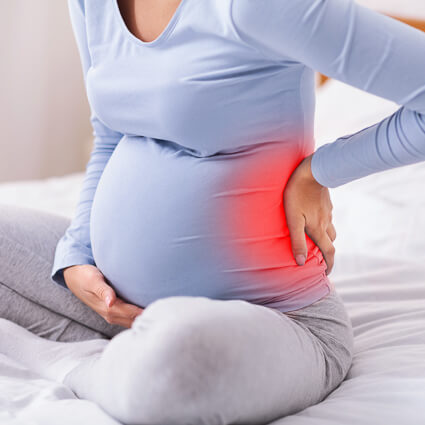
Back pain during pregnancy is common enough that most people expect it at some point, especially in the second and third trimesters.
Common Causes
- Your center of gravity moves forward. As your abdomen grows, your body naturally leans forward to compensate, which increases the curve in your lower back. That extra curve puts more stress on the muscles and joints doing the supporting.
- Hormones loosen things up (on purpose). Relaxin, one of the key pregnancy hormones, does exactly what it sounds like. It loosens the ligaments around your pelvis to prepare for childbirth. Helpful for delivery, less helpful for stability, which is part of why the low back and pelvis can start to feel unsteady.
- You’re carrying more weight. More weight means more demand on your lower back, hips, and pelvis.
- The SI joints shift. The sacroiliac joints connect your pelvis to your spine, and as pelvic mechanics change during pregnancy, pain can show up in the low back, the buttocks, or right around those joints.
- Muscles get tired. Your abs and back muscles are adapting to a body that’s changing week to week (which is a lot to ask of them). Standing, walking, lifting, or sitting for too long can wear out the muscles trying to hold everything steady.
- Sleep gets harder. Finding a comfortable position gets trickier as pregnancy goes on, and staying in one spot too long overnight often shows up as stiffness the next morning.
What Can Help?
For back pain that’s mechanical, which is most pregnancy-related back pain, a few things tend to make a real difference. Staying reasonably active with your OB’s sign-off goes a long way, and that usually means walking or other pregnancy-appropriate movement rather than pushing through a workout that doesn’t feel right anymore.
Strengthening the core, hips, and pelvic muscles helps too, as long as it’s done the right way for where you are in pregnancy. Beyond exercise, small adjustments matter: avoiding long stretches of sitting or standing, using supportive pillows at night, and paying closer attention to how you lift and bend.
For a lot of patients, working with a prenatal-trained chiropractor or physical therapist makes the biggest difference of all.
“Every pregnancy is different, and so is every back. I don’t hand out the same exercises to every patient. I want to know how you’re moving, sleeping, and feeling week to week, so care can actually keep up with what your body’s doing,” says Madison chiropractor Dr. Chris Hoover.
When Back Pain During Pregnancy Needs Medical Attention
Not all pregnancy back pain is mechanical, and that distinction matters. Call your OB or maternity provider promptly if back pain is severe, sudden, or persistent, or if it shows up alongside any of the following:
- Vaginal bleeding
- Fever
- Painful urination
- Abdominal pain or cramping
- Regular contractions
- Fluid leakage
- New leg weakness or numbness
- Loss of bladder or bowel control
Occasionally, back pain in pregnancy points to something that needs a closer look. Trust that instinct if something feels off.
Care That Changes With Your Pregnancy
Most pregnancy-related back pain is mechanical, and it usually responds well to conservative care. But “conservative” doesn’t mean generic. What helps at 14 weeks isn’t necessarily what helps at 34, and care should shift along with your pregnancy and your specific situation.
If your back has been slowing you down, reach out to Back Care Plus Inc today to book a prenatal appointment.